Driving the Future of Climate-Ready Photovoltaics across Europe and Latin America
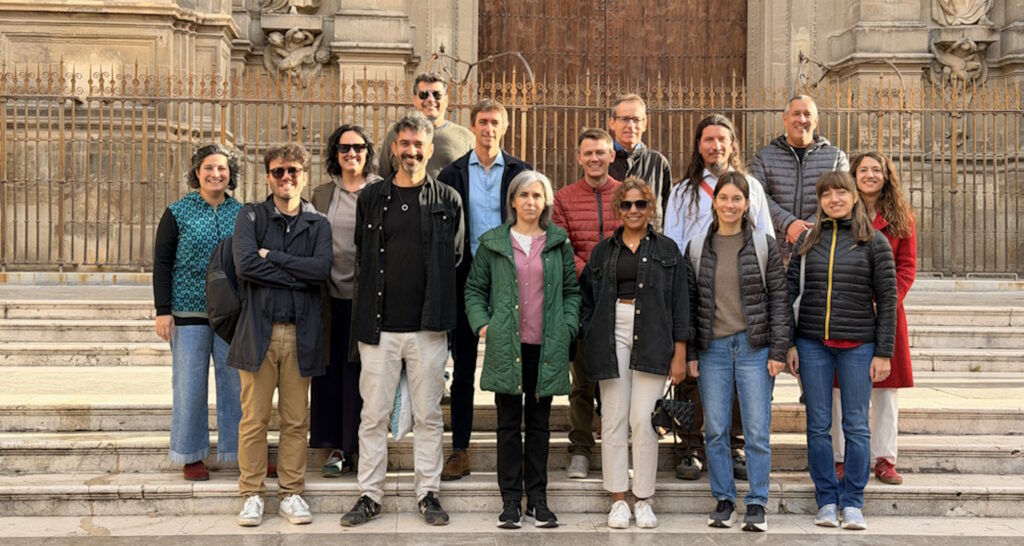
Granada, Spain, from 3rd to 5th November 2025, the Project CACTUS have organised its 4th General Assembly which included a partners meeting, a detailed project workshop and site visit.
The meeting served as a critical milestone to assess the project’s advanced stage and strategically prepare for its final review and reporting processes.
The assembly confirmed significant progress across all work packages. Key technical achievements include the completion of over a year of data collection for the soiling assessment round-robin led by ATAMOSTEC, the full delivery of advanced characterization services at ESRF/ILL, in collaboration with CEA, and the successful launch of the open-access data platform at cactus-datasets.com, led by UNC. Capacity-building and knowledge exchange activities, led by CEA, are notably ahead of schedule, with the recent involvement and exchanges between CEA, UNC, Tecnalia, Eurac Research and EUSolaris/University of Granada. The working group, led by Eurac Research, has finalized a comprehensive white paper on Research Infrastructure (RI) sustainability.
A primary focus was the detailed roadmap for the upcoming final project reporting period and the subsequent Final Review Meeting, expected to be held in February 2026.
The coordination team outlined that the final technical report must provide a high-level overview of work performed and, most importantly, deliver clear evidence of the project’s impact. This involves demonstrating achievement against all quantified KPIs, including the improvement of RIs, the creation of new services, dissemination outputs, and the strengthening of EU-LAC cooperation through workshops, training, and researcher mobility.
The General Assembly was followed by a workshop on “Photovoltaics in the Energy Transition” and a technical visit to the Plataforma Solar de Almería.
Highlights of the CACTUS hybrid workshop
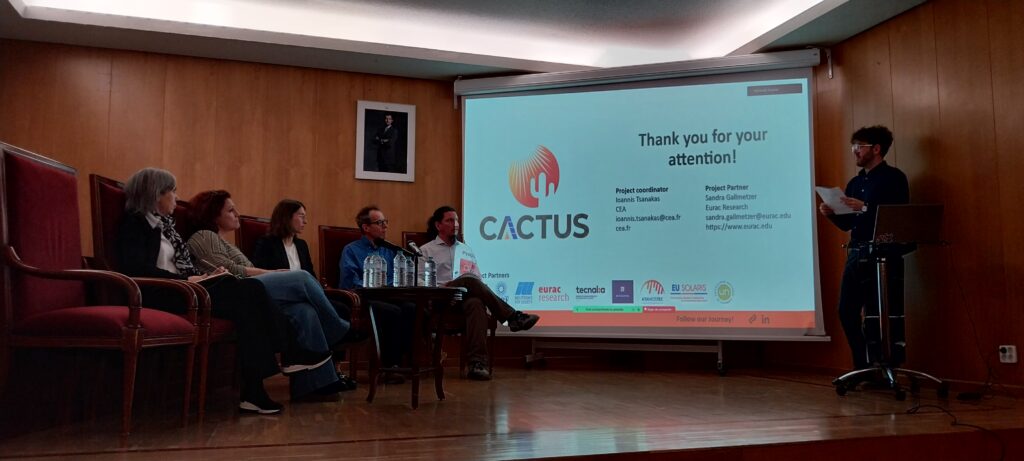
On 4 November 2025 at the University of Granada and online, a hybrid workshop has been organised by CACTUS consortium – under the EU’s Horizon Europe programme.
The part 1 addressed sustainability and climate-specific challenges in photovoltaics. Leading experts and project partners explored the social, environmental, and economic aspects of PV systems, including lifecycle impacts, ethical supply chains, and circular economy strategies. The session also examined resilience and digitalisation in PV operation and maintenance under extreme conditions, fostering knowledge exchange across Europe and Latin America and equipping participants with practical insights for implementing equitable, future-proof solar solutions.
The second training session part focused on the operation and maintenance of PV systems across diverse climates. Experts presented innovations in predictive maintenance, AI-driven monitoring, and digital tools to enhance reliability and performance in challenging environments. Participants learned strategies for adapting PV installations to extreme weather, sharing best practices to ensure resilient and efficient energy generation across different regions.
Visit to the Plataforma Solar de Almería (PSA)
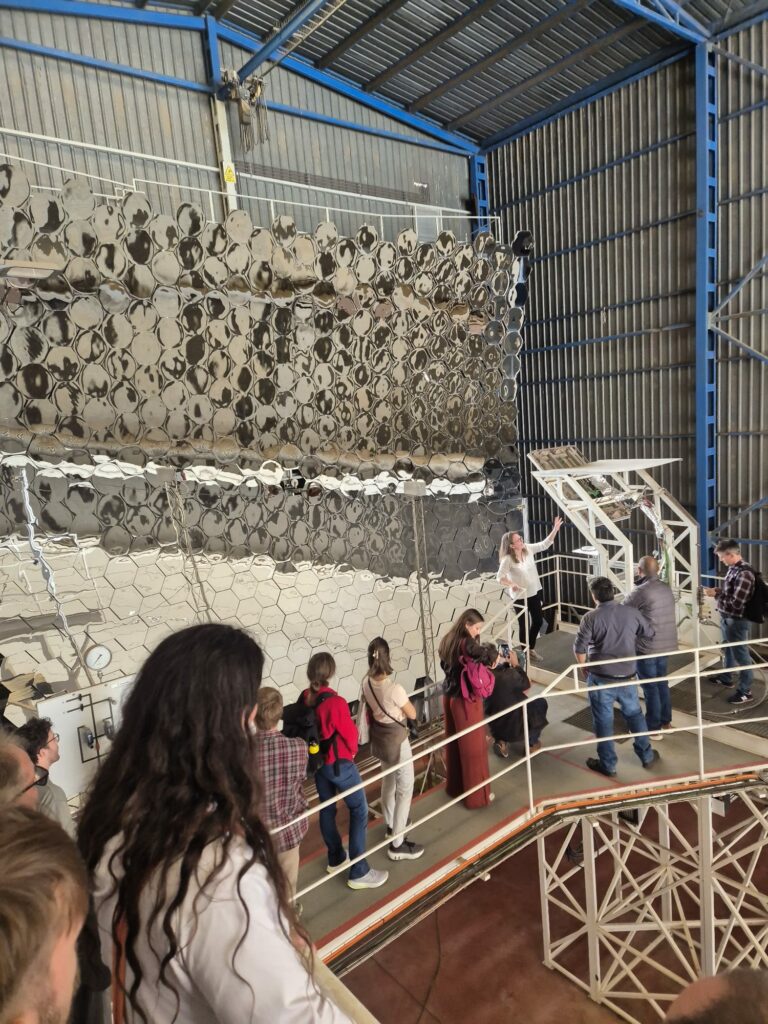
On 5 November, CACTUS partners and invited experts visited the PSA research facilities to explore state-of-the-art testing environments for photovoltaic and solar-thermal systems.
Participants observed real-world climatic stress tests on PV modules, engaged with scientists on innovation in durability and performance, and gained hands-on insights into how advanced research infrastructures support the development of resilient, climate-adapted solar technologies.